Selected engineering work / Case study
ArenaOps
An AWS backend that wakes on demand, reports readiness and returns to idle.
Built around one constraint: a multiplayer backend should not run all month just to stay clickable. ECS/Fargate slept at desired count zero, woke through a public control path, reported readiness to the visitor, ran its WebSocket workload, and returned to zero after the demo window. Terraform, IAM/OIDC and GitHub Actions made every change reviewable.
The source repository and Git history are private and preserved; this page carries the architecture, screenshots and cost evidence.
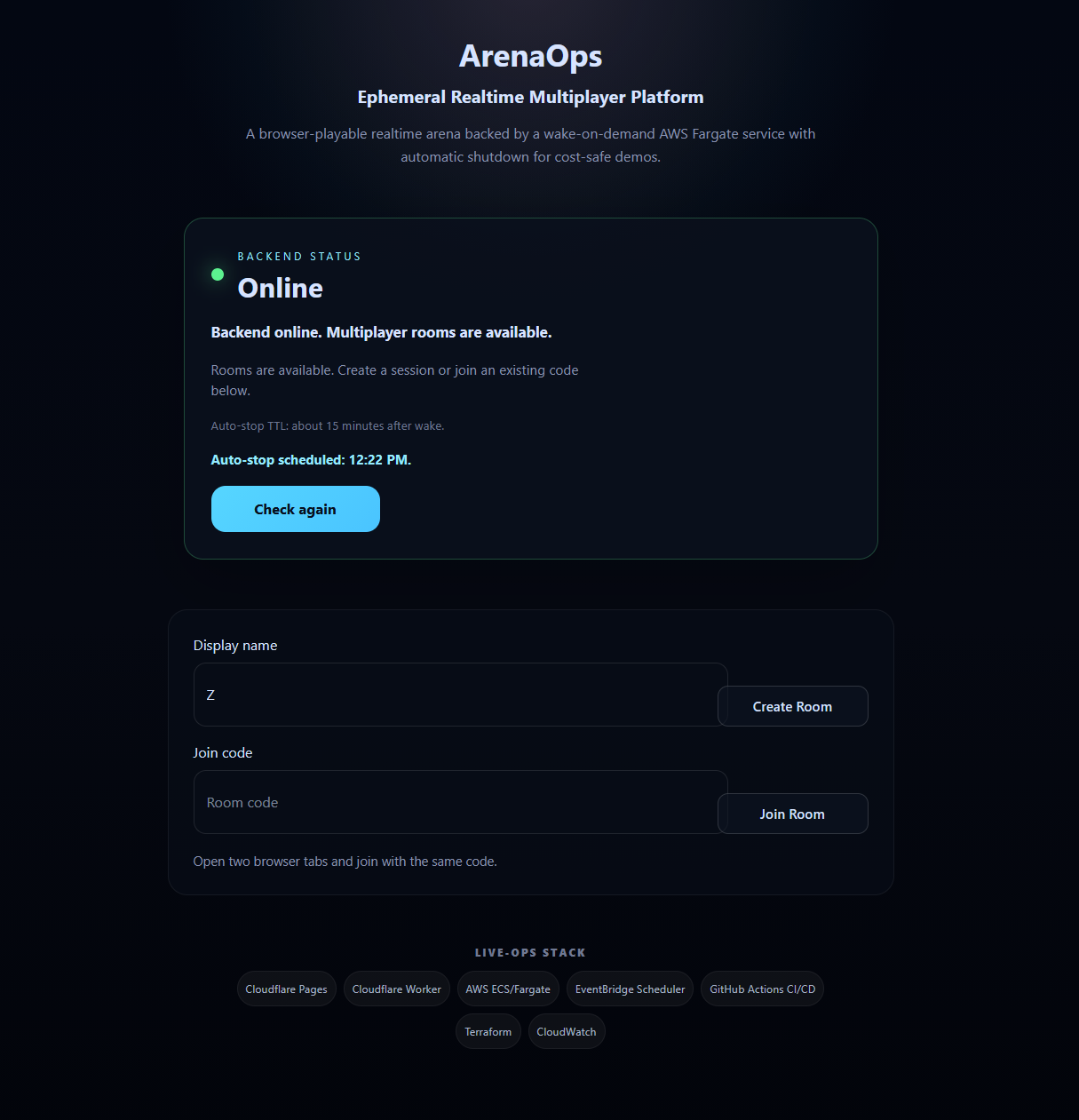
- Idle state
- ECS desired count 0
- Runtime
- ECS/Fargate + ALB
- Delivery
- Terraform + GitHub Actions + IAM/OIDC
- Status
- Retired · evidence preserved
- July 2026 cost
- ≈$24/month, ended at retirement
Project summary
- What it is
- A browser multiplayer demo whose AWS backend idled at ECS desired count zero, woke on demand and reported its state to the visitor.
- What I built
- The service lifecycle, the public wake and status path, Terraform-provisioned ECS/Fargate behind a load balancer, and GitHub Actions delivery through ECR.
- Key engineering
- Scale-to-zero with visible readiness: compute cost stopped between demos and the visitor always knew the backend’s state.
- Evidence here
- Screenshots, architecture and a July 2026 cost record (the ≈$24 monthly load-balancer baseline). The source is private and the stack was retired in August 2026, so no live endpoint remains.
01 · The operating problemA sleeping demo can look exactly like a broken one.
Keeping a portfolio backend online 24/7 wastes compute. Switching it off without product feedback creates a dead link and asks the visitor to diagnose infrastructure they cannot see.
The answer was not to hide the cold start. ArenaOps turned asleep, starting, online and shutdown into explicit user-facing states, and only enabled room controls after health checks passed.
02 · Service lifecycleOne operating loop, four legible states.
The historical lifecycle is the product demonstration. Each state had an infrastructure condition, a visitor-facing message and a clear transition rule.
-
Asleep
Zero tasks running
ECS desired count was 0. Game actions remained unavailable and the interface explained why.
desiredCount: 0 -
Starting
Wake accepted
The Worker started ECS. The frontend polled status while the ALB waited for a healthy target.
pending → health -
Online
Room controls unlock
Health passed and the browser established the WSS session with the FastAPI backend.
healthOk: true -
Shutdown
Return to zero
EventBridge Scheduler stopped the service after the demo window and cost returned to idle.
desiredCount: 0
03 · ArchitectureRuntime control and delivery stay separate.
A visitor needed low-latency lifecycle control. A deployment needed a reviewable image and infrastructure path. ArenaOps gave each concern its own lane.
Visitor and runtime path
- 01Cloudflare PagesReact + Phaser frontend
- 02Cloudflare WorkerWake and status API
- 03Application Load BalancerHTTPS / WSS and health
- 04ECS / FargateFastAPI WebSocket service
- 05EventBridgeScheduled return to zero
Build and deployment path
- 01GitHub ActionsOIDC-authenticated workflow
- 02Amazon ECRVersioned backend image
- 03ECS deploymentTask and service update
- 04CloudWatchWake, health, traffic, shutdown
Terraform · IAM · remote state · security boundaries · health checks · operational logs
04 · Working evidenceThe operating loop is visible in the interface.
These captured live-demo screens are not a fabricated dashboard. They preserve the state before access, shown above, and the realtime room once the backend was ready.
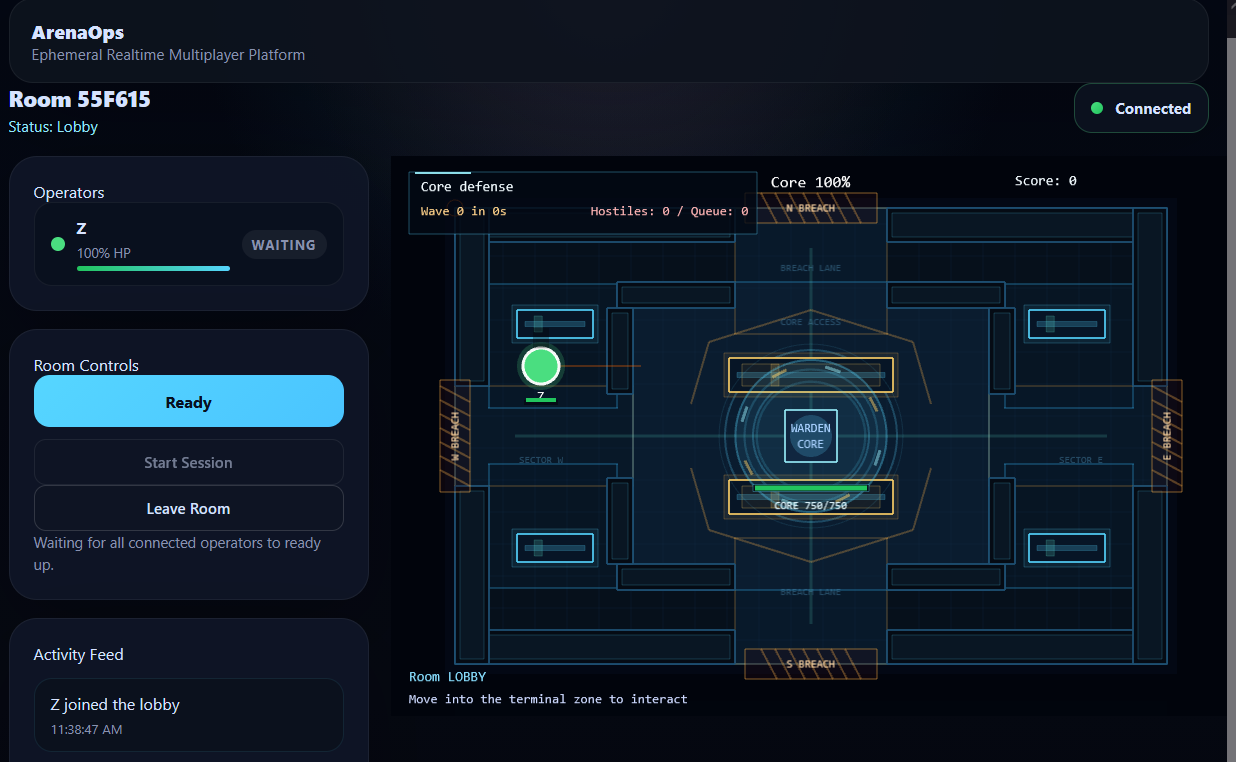
Room controls stayed disabled until the status check reported online. By the time this screen was reachable, the wake, the health check and the WSS handshake had all succeeded in order.
05 · Engineering ownershipWhat I designed and implemented.
Lifecycle contract
Defined the asleep, starting, online and shutdown states and made them part of the frontend experience.
Public control boundary
Separated visitor-triggered wake and status control from the slower deployment workflow.
Cloud delivery
Provisioned infrastructure with Terraform, authenticated GitHub Actions to AWS through IAM/OIDC, and delivered backend images through ECR to ECS.
Failure-aware operations
Worked through IAM scope, CORS, ALB target health, Scheduler payloads, WebSockets, logs and remote state.
06 · Retirement decisionStop paying when the lesson is already proven.
Scale-to-zero eliminated idle Fargate compute, but July 2026 still produced about $24.25 in ArenaOps-only baseline charges, almost all of it the load balancer and its public addresses.
The AWS stack was removed through its reviewed Terraform state boundary. The application source, infrastructure definitions, workflows, Git history, documentation and working screenshots were preserved, so the project keeps its portfolio value without recurring runtime cost.
07 · BoundariesA focused cloud demo, not a production-scale platform.
- Cold-start delay was deliberate and communicated.
- HTTP 503 while asleep was expected behavior.
- No high-availability or production-traffic claim is made.
React · TypeScript · Phaser · FastAPI · WebSockets · Docker · ECS/Fargate · ALB · ECR · IAM · EventBridge Scheduler · CloudWatch · Terraform · S3 remote state · GitHub Actions · Cloudflare Pages · Cloudflare Workers
Next: Food Checker, a label scanner with a full delivery path.